
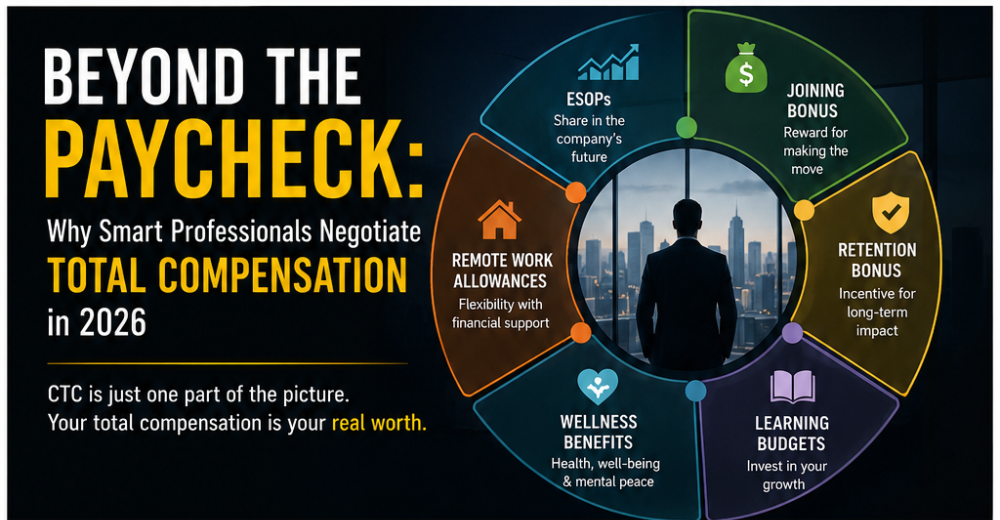
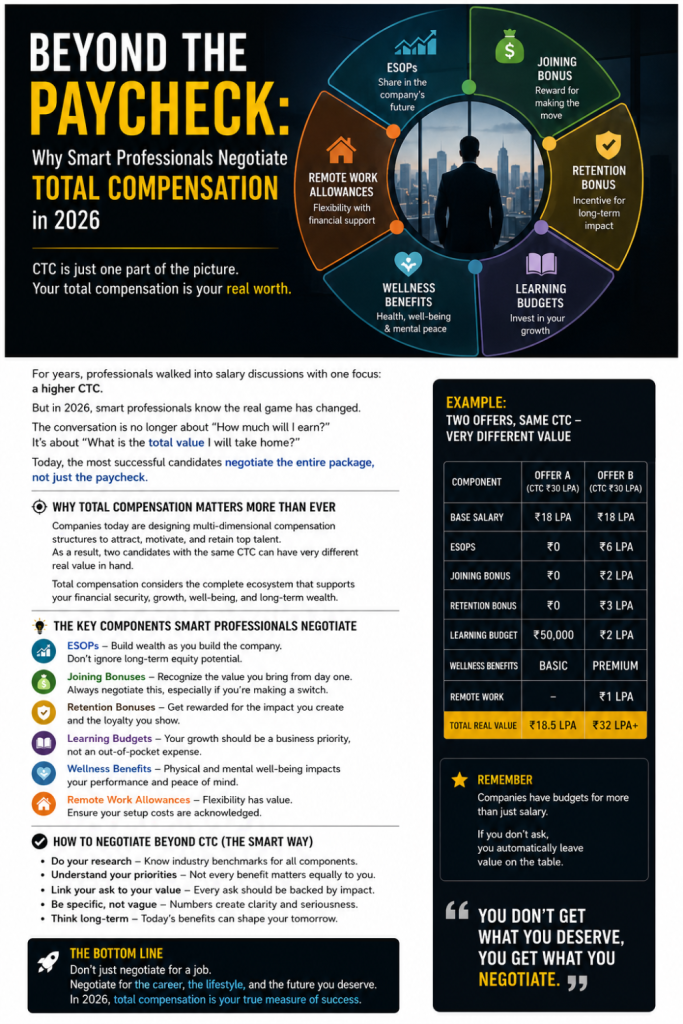
The smartest professionals are negotiating total compensation, not just salary.
For years, most professionals approached salary negotiations with one primary question:
“What’s the fixed CTC?”
But the hiring landscape is changing rapidly.
In 2026, compensation conversations are becoming far more strategic.
Top candidates are no longer evaluating opportunities based only on annual salary.
They are negotiating the entire value ecosystem around the role.
Because the reality is simple:
Two offers with the same CTC can create completely different financial outcomes and career trajectories.
And the professionals who understand this are gaining a significant advantage.
The Shift From Salary to Total Compensation
Modern compensation structures now extend far beyond monthly pay.
Professionals are becoming smarter about negotiating:
- ESOPs
- Joining bonuses
- Retention bonuses
- Learning and certification budgets
- Wellness benefits
- Remote work allowances
- Flexible work policies
- Performance-linked incentives
- Leadership exposure
- International opportunities
This is changing the way high-value candidates evaluate offers.
Because compensation is no longer just about what you earn today.
It’s about:
- Long-term wealth creation
- Career acceleration
- Skill growth
- Lifestyle flexibility
- Financial security
- Future market positioning
Why This Trend Is Growing Fast
Companies are competing aggressively for high-performing talent.
At the same time, professionals are becoming more aware of the hidden value inside compensation structures.
For example:
A candidate accepting a ₹40 LPA offer with strong ESOP potential, remote flexibility, executive mentorship, and learning budgets may create far greater long-term value than someone accepting ₹43 LPA with none of those advantages.
The smartest negotiations now focus on:
“What does this opportunity help me build over the next 3–5 years?”
Not just:
“What’s the highest number today?”
The Most Underrated Negotiation Areas in 2026
1. ESOPs Are Becoming Wealth Multipliers
In growth-stage companies, ESOPs are no longer “extra perks.”
For many professionals, they represent the largest future upside.
Candidates are increasingly asking:
- What is the vesting structure?
- What is the company valuation?
- What are the liquidity opportunities?
- What percentage growth is expected?
Professionals who understand equity conversations negotiate from a stronger position.
2. Learning Budgets Are Career Accelerators
Top candidates now negotiate for:
- Executive coaching
- Global certifications
- AI training programs
- Industry conferences
- Leadership development
Because in a rapidly evolving market, skill growth directly impacts future compensation.
3. Remote Work Has Financial Value
Remote and hybrid flexibility are now part of compensation.
Professionals increasingly calculate:
- Relocation savings
- Commute savings
- Lifestyle flexibility
- Productivity improvements
- Time recovery
In many cases, flexibility creates value equivalent to several lakhs annually.
4. Retention and Joining Bonuses Are Strategic Leverage
Companies use bonuses to secure top talent quickly.
Smart professionals negotiate these components strategically instead of focusing only on annual salary.
Especially when:
- Leaving unvested bonuses
- Relocating cities
- Joining high-pressure growth environments
- Transitioning from stable organizations
What Most Candidates Still Get Wrong
Many professionals still negotiate emotionally.
They focus only on increasing the fixed number while ignoring:
- Long-term upside
- Career growth opportunities
- Strategic exposure
- Learning ROI
- Financial flexibility
That approach can become expensive over time.
Because compensation is no longer just a payroll conversation.
It is now a strategic career decision.
The Professionals Who Win in 2026 Will Think Differently
The strongest negotiators are no longer asking:
“Can you increase the salary?”
They are asking:
- “What does the full compensation structure look like?”
- “What growth opportunities exist beyond salary?”
- “How is performance rewarded here?”
- “What wealth-building opportunities come with this role?”
That mindset changes the entire negotiation dynamic.
Final Thought
Salary negotiation in 2026 is evolving from a compensation discussion into a value conversation.
And professionals who understand total compensation will consistently make smarter career decisions than those focused only on fixed CTC.
Because the future belongs to candidates who negotiate strategically — not just numerically.