A few years ago, career advice was relatively simple.
People were told to become versatile.
Learn multiple skills.
Be adaptable.
Stay flexible.
Today, the rules are changing.
And AI is one of the biggest reasons why.
As I speak with recruiters, hiring managers, and professionals across industries, one trend is becoming increasingly clear:
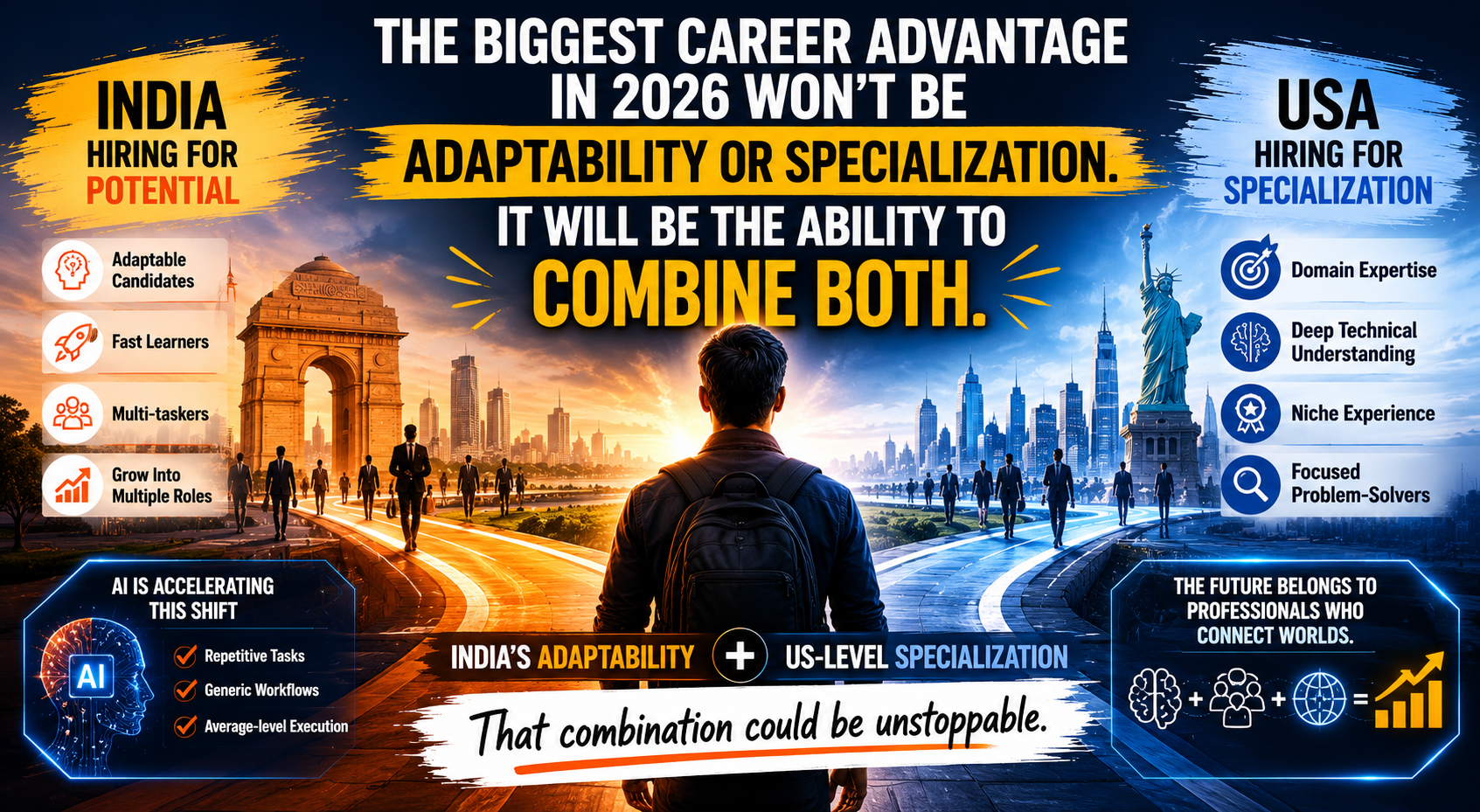
The future doesn’t belong to generalists. And it doesn’t belong to specialists alone either.
It belongs to professionals who know how to operate at the intersection of both.
The Rise of the “T-Shaped Professional”
Companies are no longer searching for employees who fit neatly into a single category.
They want people who possess:
✔ Deep expertise in one area
and
✔ Broad understanding across multiple functions
Think about the most valuable professionals in any organization today.
A Product Manager who understands technology, business, data, and customer psychology.
A Marketing Leader who can interpret analytics and leverage AI tools.
A Software Engineer who understands business strategy.
A Finance Professional who can communicate insights to non-financial stakeholders.
These individuals aren’t just specialists.
They’re specialists who can connect dots.
And that’s becoming a major competitive advantage.
Why AI Is Redefining Talent Value
AI is getting remarkably good at executing predictable tasks.
It can:
- Generate reports
- Analyze large datasets
- Write first drafts
- Automate workflows
- Handle repetitive processes
But AI still struggles with:
- Judgment
- Context
- Cross-functional thinking
- Strategic decision-making
- Human influence
- Ambiguous problem-solving
That’s why organizations are shifting their focus.
The question is no longer:
“Can this person perform the task?”
The question is increasingly:
“Can this person solve a complex business problem?”
And solving business problems rarely requires one skill.
It requires many.

The New Hiring Divide
I’ve observed two distinct talent trends emerging globally.
Some organizations are aggressively hiring deep specialists.
Others are looking for highly adaptable professionals who can thrive in uncertainty.
But the highest-paying opportunities often sit in the middle.
Companies are willing to pay a premium for professionals who can:
- Go deep when expertise is needed
- Go broad when collaboration is required
- Learn quickly when industries change
- Lead effectively when complexity increases
In other words:
Depth gets you noticed. Breadth makes you indispensable.
What This Means for Students and Professionals
Many people are asking:
“Should I become a specialist or a generalist?”
I believe that’s the wrong question.
A better question is:
“What should I specialize in, and what adjacent skills should I understand?”
For example:
A data analyst who understands business strategy.
A recruiter who understands employer branding.
A product manager who understands AI.
A sales professional who understands data.
A marketer who understands automation.
These combinations create disproportionate value.
And disproportionate value often leads to disproportionate compensation.
The Professionals Who Will Thrive in 2030
The next generation of top performers won’t be defined by job titles.
They’ll be defined by their ability to bridge disciplines.
They’ll combine:
- Technical depth with business acumen
- Analytical thinking with creativity
- Specialization with adaptability
- AI capabilities with human judgment
Because in a world where technology continues to level the playing field, the biggest differentiator won’t be what you know.
It will be how many worlds you can connect.
Final Thought
For years, career growth was about choosing between being a generalist or a specialist.
That debate is becoming outdated.
The professionals who will create the most impact in the AI era won’t choose one side.
They’ll master one domain deeply while developing the ability to operate across many.
The future belongs to people who are experts in something—and valuable in everything around it.
What do you think?
Will the next decade reward deep specialists, adaptable generalists, or professionals who successfully combine both?