If you’ve spoken to any HR professional, recruiter, or business owner recently, you’ve probably heard the same concern:
“We’re getting plenty of applications, but very few qualified candidates.”
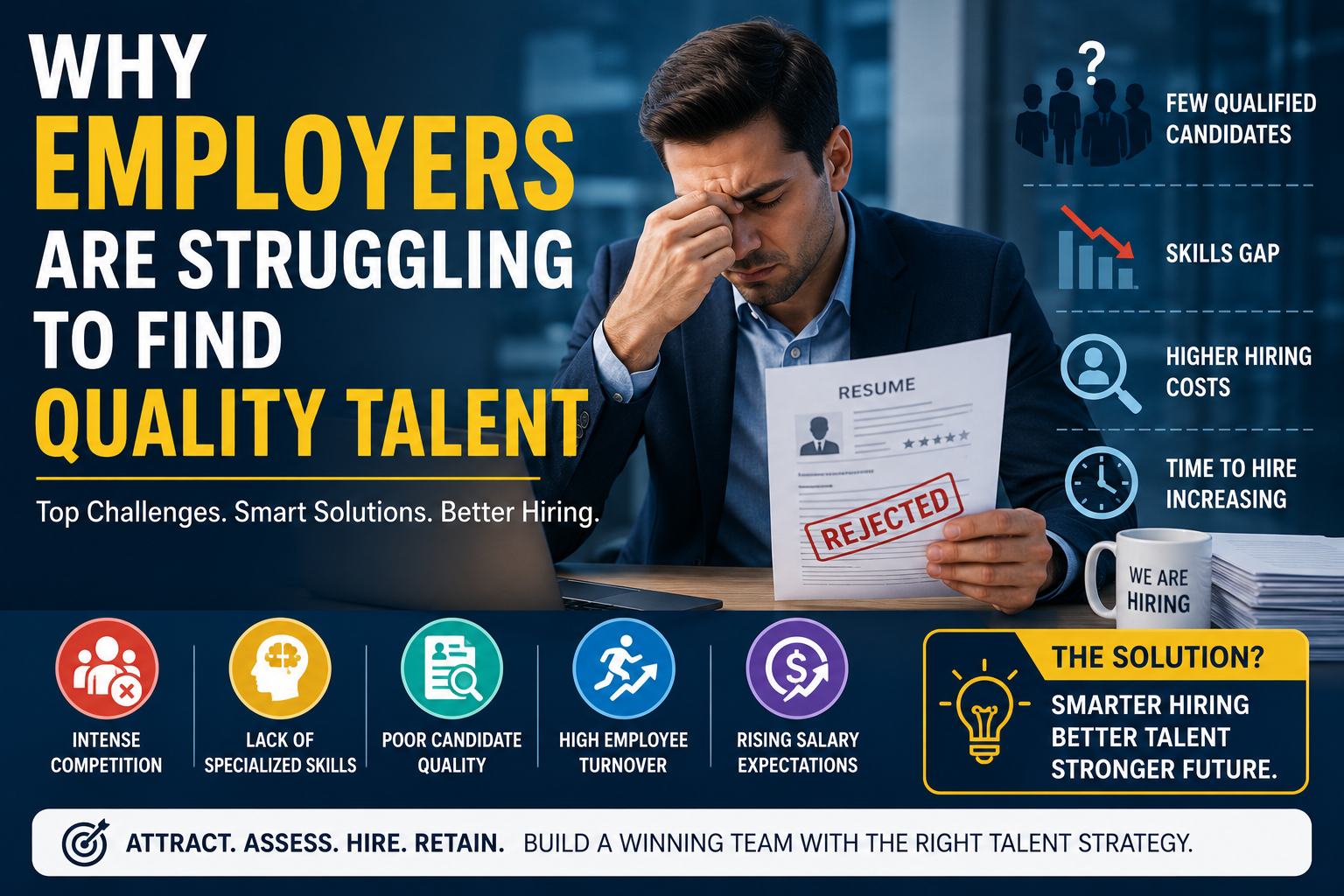
Despite millions of people actively searching for jobs across India, many companies are finding it increasingly difficult to hire the right talent. This growing disconnect between employers and job seekers has become one of the biggest recruitment challenges of 2026.
The issue isn’t a shortage of applicants—it’s a shortage of candidates who possess the right combination of skills, experience, attitude, and adaptability.
So, why are employers struggling to find quality talent, and what can businesses and job seekers do about it?
Let’s explore the key reasons behind this hiring challenge.
The Talent Shortage Is Real
India produces millions of graduates every year, yet employers across industries—from Banking and Finance to IT, Healthcare, Manufacturing, and BPO—continue to report difficulties filling open positions.
Companies are hiring, but the expectations from candidates have changed dramatically. Employers are no longer looking for someone who simply meets the educational requirements. They want professionals who can contribute from day one, adapt quickly, and grow with the business.
1. The Skills Gap Is Getting Wider
One of the biggest reasons employers struggle to hire quality talent is the widening skills gap.
Many candidates possess academic qualifications but lack practical, job-ready skills.
Recruiters often find that applicants have limited exposure to:
- Business communication
- Digital tools
- Data analysis
- Customer relationship management
- Problem-solving
- Industry-specific software
- Artificial Intelligence (AI) tools
As technology evolves faster than traditional education, employers are investing more time and resources in training new hires.
2. Degrees No Longer Guarantee Employability
A degree may help candidates qualify for an interview, but it no longer guarantees employment.
Today’s recruiters focus on practical abilities such as:
- Relevant work experience
- Industry certifications
- Internship experience
- Portfolio projects
- Technical skills
- Professional attitude
Candidates who continuously learn and upgrade their skills are often preferred over those who rely solely on academic qualifications.
3. Communication Skills Are a Major Concern
Across industries, communication remains one of the most sought-after skills.
Many technically qualified candidates struggle to:
- Express ideas clearly
- Interact confidently with clients
- Write professional emails
- Participate effectively in team discussions
- Present solutions during interviews
For customer-facing roles in Banking, Finance, Sales, Insurance, and BPO, communication skills often become the deciding factor in hiring.
4. Lack of Practical Experience
Employers increasingly prefer candidates who can contribute immediately.
However, many applicants have little or no practical exposure.
Recruiters value:
- Internships
- Freelance work
- Live projects
- Volunteer experience
- Industry certifications
- Hands-on training
Even fresh graduates who have completed practical projects often outperform candidates with only classroom knowledge.
5. Rapid Technological Change
The workplace is evolving faster than ever.
Artificial Intelligence, automation, cloud computing, digital banking, data analytics, and cybersecurity are transforming almost every industry.
Employers need professionals who are comfortable using technology and willing to adapt to new tools.
Unfortunately, many candidates fail to keep their technical skills updated.
6. Unrealistic Salary Expectations
Salary expectations have changed significantly in recent years.
Some candidates expect salaries that don’t align with:
- Their experience
- Their skill level
- Market conditions
- Industry standards
Successful hiring requires a balance between employer budgets and candidate expectations.
Professionals who focus on learning and career growth often achieve higher salaries over time.
7. Job Hopping Is Increasing
Frequent job changes have become more common.
While changing jobs for career growth is normal, employers may hesitate when they see multiple short-term roles without clear progression.
Recruiters often look for:
- Stability
- Career progression
- Long-term commitment
- Consistent performance
Candidates should be prepared to explain career transitions positively during interviews.
8. Employers Want More Than Technical Skills
Technical expertise is important, but it isn’t enough.
Recruiters increasingly assess soft skills such as:
- Adaptability
- Leadership
- Emotional intelligence
- Collaboration
- Accountability
- Time management
- Customer focus
- Learning mindset
These qualities help employees succeed in fast-changing work environments.
9. Poor Resume Quality
Many excellent candidates miss interview opportunities because of poorly prepared resumes.
Common mistakes include:
- Generic resumes
- Missing keywords
- Poor formatting
- Spelling mistakes
- No measurable achievements
- Outdated information
An ATS-friendly, well-structured resume significantly improves a candidate’s chances of getting shortlisted.
10. The Hiring Process Has Become More Competitive
In many industries, a single vacancy can receive hundreds of applications.
Recruiters now use technology to filter candidates quickly.
Applicants who don’t tailor their resumes, optimize their LinkedIn profiles, or prepare for interviews often get overlooked.
Standing out requires preparation, consistency, and continuous improvement.
What Employers Are Looking for in 2026
Modern employers seek professionals who combine technical expertise with strong interpersonal skills.
Some of the most valuable qualities include:
- Problem-solving ability
- AI and digital literacy
- Business communication
- Team collaboration
- Customer-centric thinking
- Industry knowledge
- Analytical skills
- Adaptability
- Integrity
- Continuous learning
Candidates who demonstrate these qualities are more likely to receive interview calls and long-term career opportunities.
How Employers Can Attract Better Talent
Recruitment is a two-way process. Companies also need to create an environment that attracts quality candidates.
Some effective strategies include:
- Writing clear and detailed job descriptions
- Offering competitive compensation
- Building a strong employer brand
- Providing career development opportunities
- Streamlining the hiring process
- Offering flexible work options where possible
- Communicating regularly with candidates
- Investing in employee learning and development
Organizations that focus on candidate experience often attract stronger talent and improve hiring success.
How Job Seekers Can Become More Employable
Candidates can significantly improve their career prospects by:
- Learning in-demand technical skills
- Building AI literacy
- Improving communication skills
- Completing professional certifications
- Gaining internship or project experience
- Creating an ATS-friendly resume
- Keeping their LinkedIn profile updated
- Practicing interview techniques
- Following industry trends
- Applying strategically instead of randomly
Employability is no longer about having a degree—it’s about demonstrating value.
The Future of Hiring in India
India’s employment market is expected to continue growing, especially in sectors such as:
- Banking & Financial Services
- Information Technology
- FinTech
- Insurance
- Healthcare
- Digital Marketing
- BPO & KPO
- Manufacturing
- Renewable Energy
- Artificial Intelligence
The companies that invest in people and the professionals who invest in learning will be best positioned for success in the years ahead.
The challenge of finding quality talent isn’t caused by a lack of job seekers—it’s driven by a mismatch between employer expectations and candidate readiness.
Businesses need professionals who are skilled, adaptable, and eager to learn, while job seekers must focus on continuous development, practical experience, and professional presentation.
For employers, building a strong recruitment strategy and employer brand is essential. For candidates, staying updated with industry trends, improving technical and soft skills, and maintaining a professional resume can make all the difference.
At GrowEdge Jobs, we help bridge the gap between employers and job seekers by connecting businesses with qualified professionals across Banking, Finance, Insurance, BPO, IT, Healthcare, Sales, and many other industries. Whether you’re hiring top talent or searching for your next career opportunity, GrowEdge Jobs is your trusted recruitment partner.