Not long ago, hiring a new employee was a time-consuming process. Recruiters spent hours reading resumes, scheduling interviews, responding to candidates, and coordinating with hiring managers. Today, that process is changing rapidly.
Artificial Intelligence (AI) is reshaping recruitment across India. From resume screening and candidate matching to interview scheduling and workforce analytics, AI is helping companies hire faster, smarter, and more efficiently.
However, despite the rise of automation, recruitment is still about people. AI is not replacing recruiters—it is empowering them to make better hiring decisions while allowing them to spend more time building relationships with candidates.
Whether you’re an employer looking to improve your hiring process or a job seeker preparing for the future of work, understanding how AI is transforming recruitment in India is essential.
What Is AI Recruitment?
AI recruitment refers to the use of Artificial Intelligence and machine learning technologies to simplify, automate, and improve different stages of the hiring process.
Instead of manually reviewing thousands of applications, recruiters can use AI-powered tools to identify suitable candidates, predict hiring success, automate repetitive tasks, and improve the overall recruitment experience.
The goal is not to replace human judgment but to make recruitment more efficient, accurate, and data-driven.
Why AI Is Becoming Essential in Recruitment
India’s job market has become highly competitive.
A single job opening can receive hundreds—or even thousands—of applications within days. Managing this volume manually is becoming increasingly difficult.
AI helps organizations:
- Reduce hiring time
- Improve candidate matching
- Lower recruitment costs
- Minimize manual work
- Enhance candidate experience
- Make data-driven hiring decisions
Companies of all sizes, from startups to multinational corporations, are now investing in AI-powered recruitment solutions.
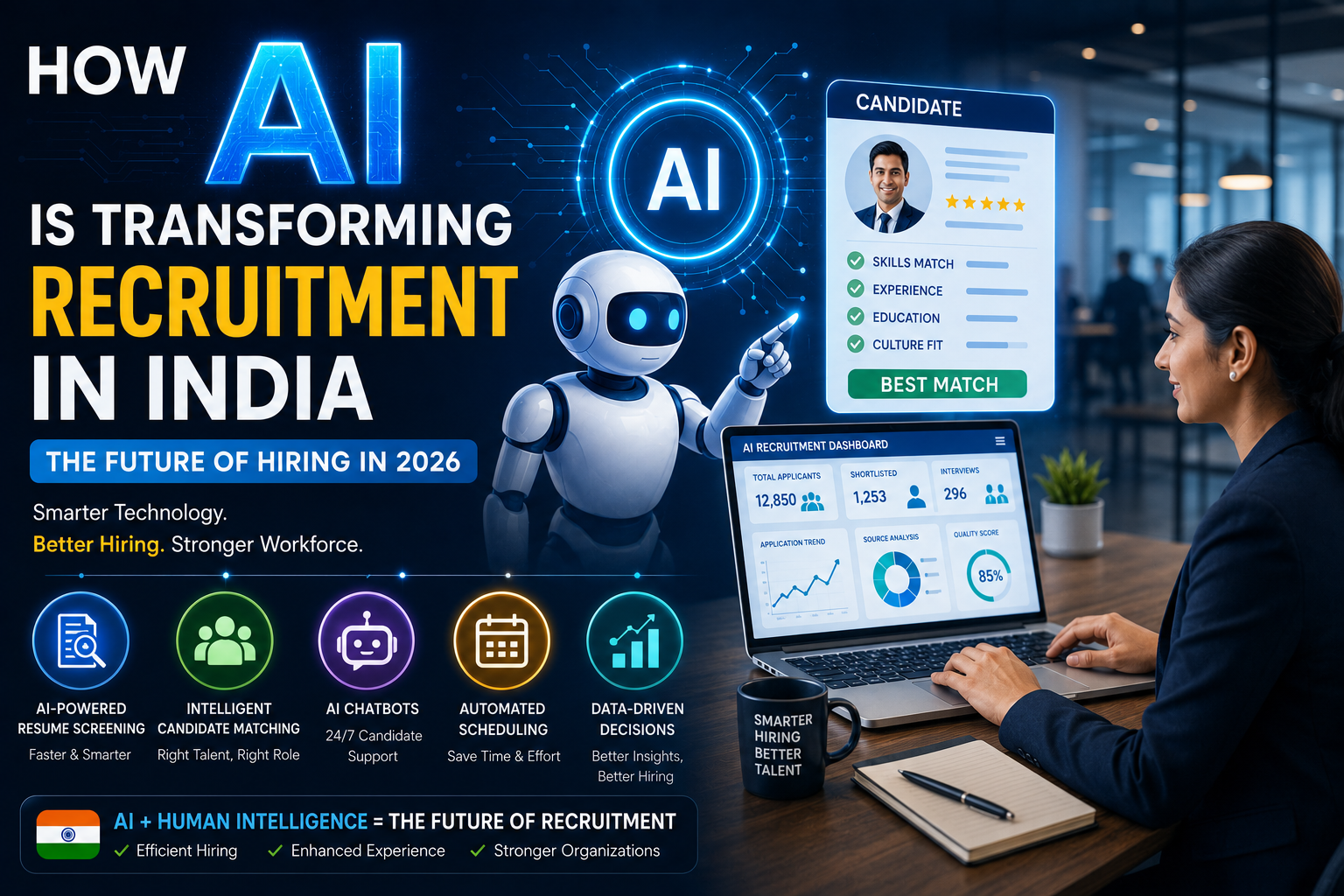
1. Faster Resume Screening
One of the biggest challenges recruiters face is reviewing large numbers of resumes.
AI-powered Applicant Tracking Systems (ATS) can quickly scan resumes and identify candidates who match the job requirements.
Instead of spending hours filtering applications, recruiters receive a shortlist of candidates whose skills, experience, and qualifications closely align with the role.
This allows hiring teams to focus their attention on interviewing the most relevant applicants.
2. Better Candidate Matching
Traditional recruitment often relies on keyword searches.
Modern AI tools go much further.
They analyze:
- Skills
- Work experience
- Certifications
- Career progression
- Industry expertise
- Job preferences
- Learning potential
By evaluating multiple factors simultaneously, AI helps recruiters discover candidates who may have been overlooked through manual screening.
For employers, this leads to stronger hiring decisions.
For job seekers, it creates opportunities based on actual capabilities rather than just resume formatting.
3. Smarter Job Recommendations
Many leading job portals now use AI to recommend jobs that closely match a candidate’s profile.
Instead of searching manually through hundreds of listings, candidates receive personalized recommendations based on:
- Skills
- Experience
- Preferred location
- Industry
- Salary expectations
- Previous applications
This saves time while improving the chances of finding relevant opportunities.
4. AI-Powered Chatbots Improve Candidate Experience
Candidates often have simple questions during the hiring process.
For example:
- Has my application been received?
- What is the interview schedule?
- What documents should I bring?
- What are the job responsibilities?
AI chatbots provide instant answers around the clock.
This improves communication while reducing the workload on recruitment teams.
Candidates appreciate faster responses, and recruiters spend less time answering repetitive questions.
5. Automated Interview Scheduling
Scheduling interviews can become complicated when multiple candidates and interviewers are involved.
AI-powered scheduling systems automatically:
- Check calendar availability
- Suggest interview slots
- Send invitations
- Share reminders
- Handle rescheduling
This eliminates countless emails and speeds up the hiring process.
6. Reducing Time-to-Hire
In competitive industries, hiring delays often result in losing top candidates.
AI helps organizations move faster by automating routine tasks such as:
- Resume screening
- Candidate communication
- Interview scheduling
- Initial assessments
Recruiters can therefore spend more time evaluating talent and less time managing administrative work.
7. Improving Recruitment Analytics
AI doesn’t just help companies hire—it also helps them hire better.
Recruitment dashboards now provide valuable insights, including:
- Source of successful hires
- Interview-to-offer ratio
- Time-to-fill positions
- Candidate drop-off rates
- Hiring costs
- Recruiter productivity
These insights enable organizations to refine their hiring strategies over time.
8. Supporting Skills-Based Hiring
The recruitment landscape is shifting from degree-based hiring to skills-based hiring.
AI can evaluate candidates based on:
- Technical skills
- Certifications
- Project experience
- Portfolio quality
- Assessment results
This creates more opportunities for talented professionals who may not have traditional educational backgrounds but possess valuable practical skills.
9. AI in Video Interviews
Some organizations now use AI-assisted video interviews during the early stages of recruitment.
These platforms can help recruiters organize interviews, analyze responses, and highlight important information for review.
However, final hiring decisions should always involve experienced recruiters and hiring managers, ensuring that human judgment remains central to the process.
10. Predictive Hiring
One of the most exciting developments in recruitment is predictive analytics.
AI can identify patterns from previous successful hires to help recruiters understand which candidate profiles are more likely to succeed in similar roles.
While these insights can support better decision-making, they should complement—not replace—fair human evaluation.
Industries Leading AI Recruitment in India
AI adoption is growing rapidly across multiple sectors.
Some of the fastest adopters include:
Information Technology (IT)
Technology companies use AI extensively for sourcing software developers, engineers, cybersecurity specialists, and cloud professionals.
Banking & Financial Services
Banks and financial institutions use AI for large-scale hiring, risk assessment roles, digital banking, customer service, and operations.
BPO & Customer Support
High-volume recruitment makes AI particularly valuable for screening candidates and scheduling interviews.
Healthcare
Hospitals, healthcare providers, and health-tech companies use AI to recruit medical professionals and administrative staff more efficiently.
Retail & E-commerce
Retail businesses leverage AI to manage seasonal hiring and large-scale workforce planning.
Benefits of AI for Employers
Organizations using AI recruitment tools often experience:
- Faster hiring cycles
- Better candidate quality
- Reduced recruitment costs
- Improved hiring consistency
- Enhanced recruiter productivity
- Better workforce planning
- Stronger candidate engagement
Rather than replacing recruiters, AI allows HR professionals to focus on interviewing, relationship-building, and strategic talent acquisition.
Benefits of AI for Job Seekers
AI also improves the job search experience.
Candidates benefit from:
- Personalized job recommendations
- Faster application reviews
- Improved communication
- Simplified application processes
- Better matching with relevant opportunities
- Reduced waiting time
Understanding how ATS and AI systems work also helps candidates optimize their resumes with relevant skills and keywords.
Challenges of AI in Recruitment
Although AI offers many advantages, it also presents important challenges.
Employers should ensure that AI systems are:
- Fair and transparent
- Regularly reviewed for bias
- Used alongside human judgment
- Designed to protect candidate privacy
- Compliant with applicable laws and regulations
Recruitment is ultimately about people, and technology should support—not replace—thoughtful hiring decisions.
How Job Seekers Can Prepare for AI Recruitment
To improve your chances of getting noticed:
- Create an ATS-friendly resume.
- Include relevant keywords from the job description.
- Highlight measurable achievements.
- Add certifications and technical skills.
- Keep your LinkedIn profile updated.
- Build a portfolio of projects where relevant.
- Continue learning new technologies and industry skills.
Candidates who combine strong technical expertise with communication and adaptability are likely to stand out.
The Future of AI in Recruitment
AI will continue to transform recruitment over the coming years.
We can expect:
- More personalized hiring experiences
- Faster candidate matching
- Smarter workforce planning
- Increased use of predictive analytics
- Better collaboration between AI systems and human recruiters
The most successful organizations will be those that combine advanced technology with empathy, fairness, and a strong candidate experience.
Artificial Intelligence is changing recruitment in India by making hiring faster, smarter, and more efficient. From resume screening and job matching to interview scheduling and recruitment analytics, AI is helping organizations identify the right talent while improving the experience for candidates.
At the same time, successful hiring will always depend on human judgment, meaningful conversations, and a genuine understanding of people.
Whether you’re an employer searching for exceptional talent or a professional exploring your next career opportunity, embracing AI-driven recruitment can help you stay ahead in an increasingly competitive job market.
At GrowEdge Jobs, we combine modern recruitment technology with a user-friendly platform to connect talented professionals with leading employers across Banking, Finance, Insurance, IT, BPO, Healthcare, Sales, and many other industries throughout India.