Most candidates spend hours preparing the right answers.
Very few prepare for the signals they are sending.
And that’s where interviews are often won or lost.
A few weeks ago, I interviewed two candidates for a mid-senior level role.
Both had similar experience.
Both came from respected organizations.
Both performed reasonably well on technical questions.
Yet one moved forward immediately, while the other didn’t.
The difference wasn’t expertise.
It was communication.
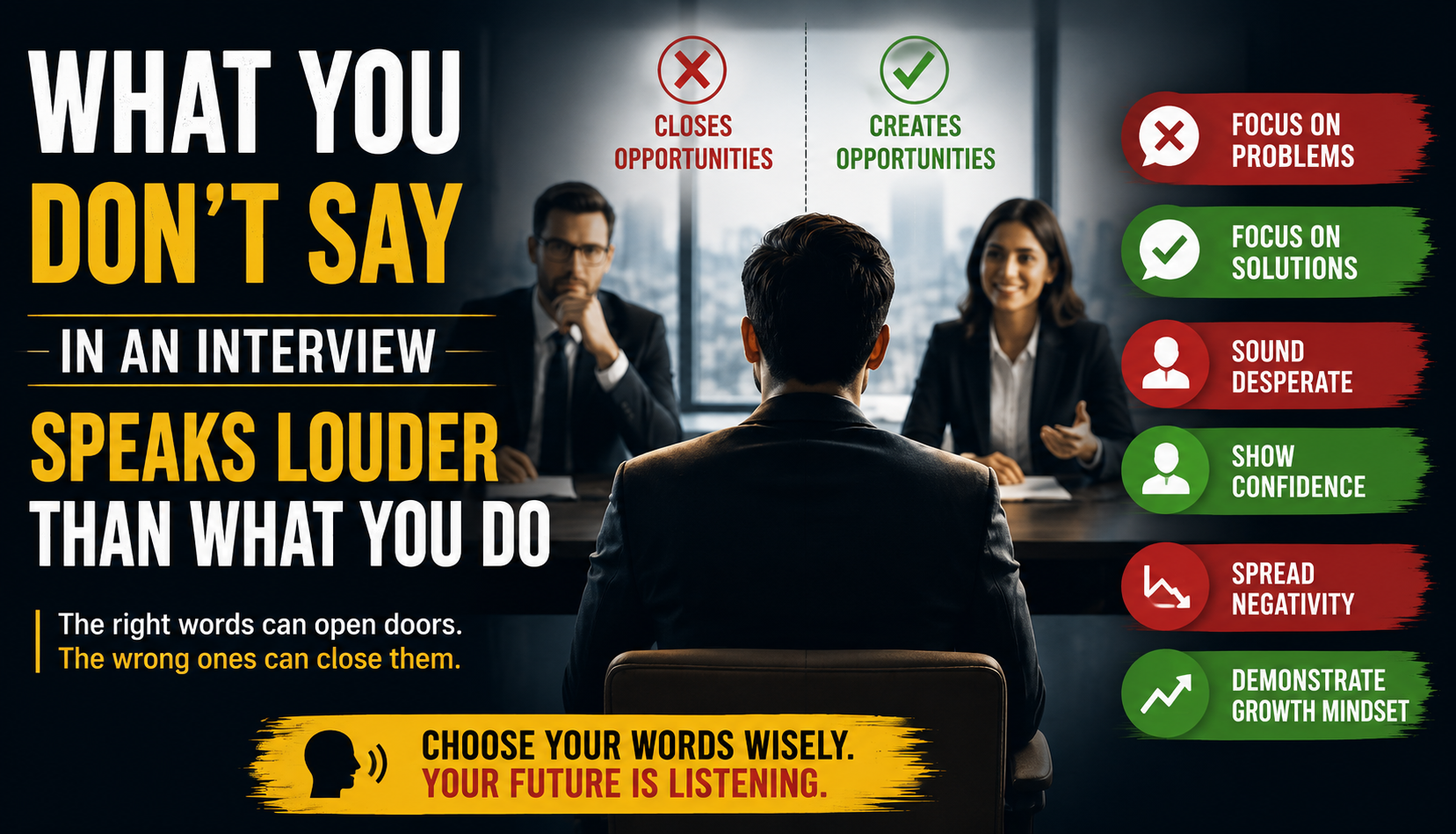
One candidate answered questions with a focus on problems.
The other answered with a focus on solutions.
That small shift completely changed how they were perceived.
For example:
When asked why he wanted to leave his current organization, one candidate said:
❌ “There is no growth, management doesn’t listen, and the culture isn’t good.”
The other said:
✅ “I’m looking for an environment where I can take on larger responsibilities and contribute to higher-impact initiatives.”
Same intention.
Completely different impression.
Here’s something many professionals overlook:
Interviewers are not only evaluating your skills.
They are evaluating:
✔ How you think
✔ How you handle challenges
✔ How you communicate under pressure
✔ How you represent the organization
✔ How you will interact with clients, stakeholders, and teammates
Every answer becomes a window into your professional maturity.
Some common phrases that unintentionally hurt candidates:
❌ “I’m desperate for a change.”
❌ “I can do anything.”
❌ “I just need a better salary.”
❌ “My manager never appreciated me.”
❌ “I don’t really have any questions.”
While these statements may be honest, they often create concerns about motivation, clarity, or professionalism.
Instead, high-performing candidates tend to communicate with intention.
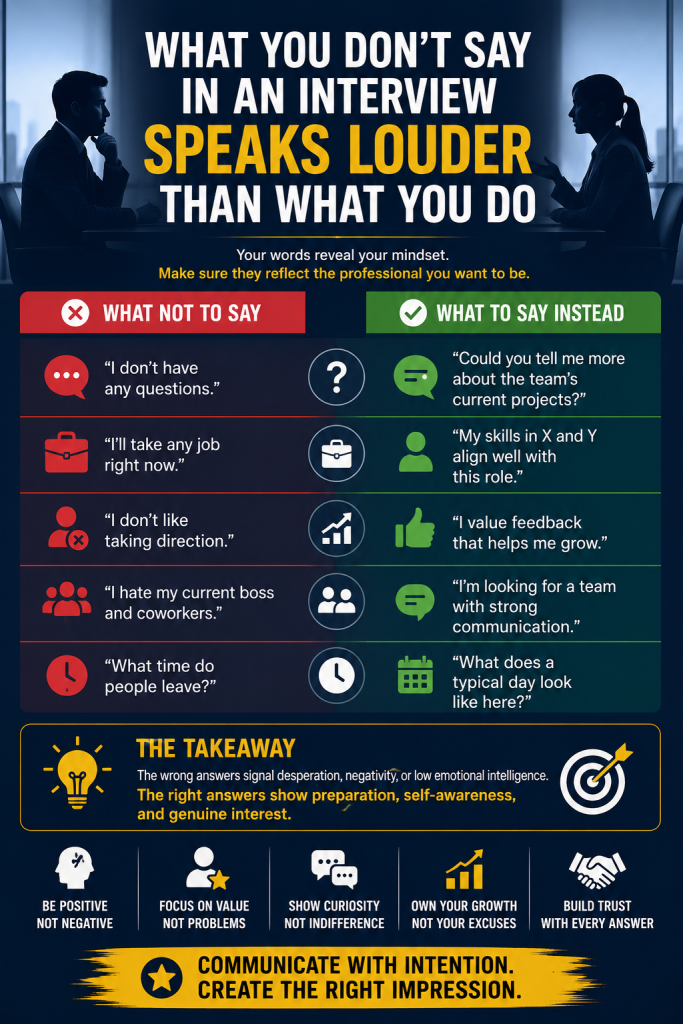
They say things like:
✅ “I’m looking for opportunities that align with my long-term career goals.”
✅ “My experience is strongest in areas where I can create measurable business impact.”
✅ “I’m exploring roles that offer both growth and meaningful challenges.”
✅ “Could you tell me more about the team’s priorities for the next 12 months?”
Notice the difference?
The strongest candidates don’t just answer questions.
They shape perceptions.
One response I remember even today came from a candidate who was asked about a skill gap.
Instead of trying to hide it, he said:
“I haven’t worked extensively in that area yet, but I’ve already started learning it. In previous roles, I’ve successfully picked up new skills quickly whenever the business required it.”
No excuses.
No defensiveness.
No attempt to bluff.
Just confidence, ownership, and a willingness to learn.
That answer carried more weight than many technically perfect responses.
The reality is this:
Interviewers don’t expect perfection.
They expect self-awareness.
They expect honesty.
And they expect professionalism.
Candidates often believe interviews are about saying impressive things.
In reality, they are about communicating credibility.
Because long after the interview ends, people may forget your exact answers.
But they remember how you made them feel about hiring you.
And sometimes, what you don’t say speaks louder than what you do.
#InterviewTips #CareerGrowth #JobSearch #Leadership #Recruitment #PersonalBranding #CareerAdvice #ProfessionalDevelopment #Hiring #InterviewPreparation